Monday, February 28, 2011

backyard chickens!?!?

You have no idea how surprised I was when Able-Bodied Boy mentioned a year or so ago that he might like to have some egg-layers. Sweeeeeet! My friend Barnhenge Momma has a few dozen egg-layers and meat birds, and she makes it look so easy. Which, it seems, it is pretty easy:

a Rhode Island Red
Buy/build coop and run. Raise chicks or buy pullets (teen-aged birds). Put them in the coop. Give them a hand with where to lay eggs (if it's the first set of birds you own, they need a bit of training since they don't have other birds to watch). Collect eggs and check water and feed daily. Clean the coop and run every 1- 2- 3- 4- weeks, depending who you talk to and the conditions. Overall, not really all that difficult!

We learned most of what we know from the PASA Backyard Chicken class we took on Saturday, led by the very knowledgeable and sweet Amy and Chris. They definitely made it seem very attainable for a lot of different folks. We also plan to spend a day with Barnhenge Mama (and Papa) to do a "chicken internship" :)

We have quite a list of things to consider before we make the plunge, though.

  • Do local ordinances allow us to have them? Is the coop a large enough structure that it needs to follow some sort of code? (Zoning officer will be dropping off information this week!)
  • Where do we put the coop and run? Will it get a mix of sun and shade, or do we need to provide some sort of shade cover (vines over the top)? Will a little smell bother you if it's close to the house, or can you combat that with fragrant flowers/herbs?
  • How do we procure the coop? DIY, help from an experienced coop-builder, buy it online...?
  • Do we get a rooster? They can help with protection when the birds are outside of their run. Are we letting them out of the run much? Will our neighbors care about the crowing?
  • Do we get chicks or pullets? Chicks take a bit of care for 3 months to raise, but the handling will get them used to you (and kids, if you have them). Is it much more expensive to get pullets?
  • Where will we get our hay/cedar chips from?
  • Do we have a reliable chicken-sitter when we are both away?
Needless today, Able-Bodied Boy and I don't really see eye-to-eye on a lot of this. Tons of discussions to come. But I'm sure we'll come up with a good plan that works for both of us!

Once we have 3-4 birds laying, we'll start getting around a dozen eggs each week. Which is quite a bit for us, but I think we can use them to barter with others for garden produce or other homemade goods. We'll also have a good bit of fertilizer to use in the garden, to supplement the worm compost. And they will eat most excess foods we don't give the worms, so we can stop putting scraps in the trash or bushline (even at Thanksgiving!).

Amusingly, mentioning all this on Facebook prompted a lot of my friends to speak up about their experiences with chicken-raising. Have you had chickens? What's the best/worst thing about it?

Much Love,
Able-Bodied Girl


EDIT: We got the copy of the relevant local code; looks like this might be a problem. For any agricultural/farming uses, we need to have 5+ acres and set the structure 200ft from the property line. With only 1.5 acres, that puts the coop under our house and still 3.5 acres short. Our property is bordered by the road on one side and by one owner's horse pasture or unused land. So there would really be no residential issue, if that's the concern.
We're going to look into the feasibility of getting a variance (will ask if it's ever been done before). If we might be able to get one, we'll try to get the neighbor's support and take our tiny coop plans to see about a variance. If it doesn't look like a variance is going to happen, we may just talk to the neighbor and/or take our chances... I'll keep you posted!

   

Sunday, February 27, 2011

mattress purchase update: the east coast organic mattress company

This has been a sustainable homesteading weekend, for sure. Yesterday we attended a class on backyard chicken operations, in preparation for the long-discussed egg layers we want. (More on that later!) The class was an hour from home, and I figured since we were already so far from home, we might as well detour another hour to one of the only eco-friendly mattress stores in our region, The East Coast Organic Mattress Company.

Now, it must be said that we got a little bit of flack for this. We were called hippies by one friend, and got blank stares from others. Able-Bodied Boy got the obligatory pats on the back in sympathy. "Seriously?!!?! Organic mattresses? Dude, have fun with that."

Really people? I honestly don't understand how this can be so weird. You opt to buy the organic veggies in the market sometimes, right? The organic dairy products? And they aren't all that different from their regular counterparts; they don't taste extraordinarily different, or have different textures. They are a little more expensive, but are conveniently located next to their counterparts, and sometimes you decide it's worth it. You might even drive over to the natural foods store to buy more products like it.

It's the same with mattresses, I suppose. The end result is that you get a bed that is comfortable, feels the best for your body type and sleep patterns. You might pay a bit more, but you have decided it's worth it.

That being said, to be honest, I think Able-Bodied Boy and I were both a little skeptical about going to a store specializing in organic mattresses. I mean, what makes a mattress organic, and can the types of materials they use compare to standard materials, and what about the durability, or the variation in firmness? I had hopes that they would be worthy of the long trip, but felt a bit of everyone else's skepticism. What if it was all just lumpy organic-wool futon pads on top of sustainably-forested wood, sold by rabid hippies that smelled vaguely of patchouli? Eeee gads!

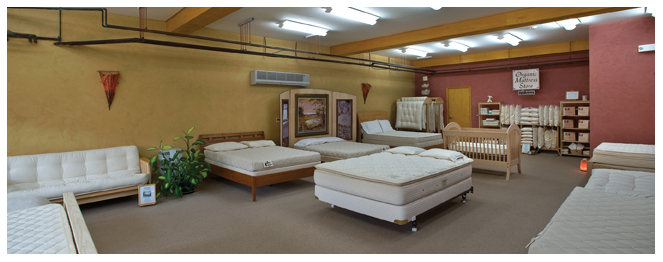
We were oh-so-pleasantly surprised! Leona, the owner, patiently led us to each bed, explained the materials, the density of the mattresses, waited for us to comment and ask questions, and even brought me a selection of organic pillows when I mentioned noticing they had quite a variety on all their beds. Anecdotally, they sounded very durable and worthy of consideration.

And the beds, oh they were so comfortable! Some were soft and quilty, some were very very firm. They had toppers and pads and multiple layers of different densities and they could even make each side different if you had two different sleep needs. They had foam mattresses and spring mattresses and a variety of foundations to match each mattress. Each mattress used a different combination of materials, but all organic (or we-can't-afford-the-certification-but-really-are-quite organic) and/or sustainably-sourced.

I won't detail all of their materials, how they are sourced, how they are made and put together, or even which ones we liked. A mattress purchase is personal, and I'm sure you'll learn everything you want/need to when it comes time.
photo from the East Coast Organic Mattress Store website
But I have to say I was really extraordinarily impressed with the East Coast Organic Mattress Store, and Leona. No stinky mattress fumes, and no patchouli :) We will definitely be considering our favorites from their store as we continue our search and decide which sort of mattress is best for us.


Have you ever gotten those skeptical looks before when you decide to try something a little outside the box? Was it worth it?

Much Love,
Able-Bodied Girl